
![Dental Bridges vs. Partial Dentures in Winston-Salem, NC [Video]](https://keiderdds.com/wp-content/uploads/2026/09/Dental-Bridges-vs.-Partial-Dentures-in-Winston-Salem-NC-Video-1200x800.jpg)
Missing teeth can affect more than just the way your smile looks. An incomplete set of teeth can also make it harder to chew comfortably and feel confident in everyday situations. Fortunately, many options are available to replace what’s gone, including partial dentures and dental bridges. When comparing dental bridges vs. partial dentures, which one is best for your smile? A dental bridge is best for replacing a few adjacent missing teeth, especially when the neighboring teeth already need crowns. On the other hand, a removable partial denture can be a practical option for replacing several missing teeth, particularly in different areas of the mouth.
Dr. Matthew Keider is a Winston-Salem dentist with over 30 years of experience completing smiles with bridges and partial dentures. He’s happy to clarify which option makes sense for you when he sees you for a personalized consultation.
Considering Dental Bridges vs. Partial Dentures? A Winston-Salem Dentist Breaks Down All Your Options
When considering dental bridges vs. partial dentures, you should know all of your options. In this helpful, comprehensive video, Dr. Keider discusses partial dentures and dental bridges as well as all of your other denture options:
Partial Denture Features, Pros, and Cons
![Dental Bridges vs. Partial Dentures in Winston-Salem, NC [Video]](https://keiderdds.com/wp-content/uploads/2026/09/Dental-Bridges-vs.-Partial-Dentures-in-Winston-Salem-NC-Video-600x400.jpg) One option to replace multiple missing teeth is a removable partial denture. It has a plastic saddle that fits over the gum ridge where teeth are missing.
One option to replace multiple missing teeth is a removable partial denture. It has a plastic saddle that fits over the gum ridge where teeth are missing.
A partial denture has small clasps or wires that hook around the natural contours of your remaining teeth. When you place the partial denture in your mouth, the clasps flex slightly around the teeth, helping hold it in place.
One of the big advantages of a partial denture is that it can replace several teeth throughout the mouth for essentially the same fee.
Something to keep in mind is that a partial denture does need to extend across the mouth for support. Even if you are replacing teeth on only one side, the partial may need to wrap around to the other side of the mouth. This means the partial may take up additional space and require a little time to get used to.
Dental Bridge Features, Pros, and Cons
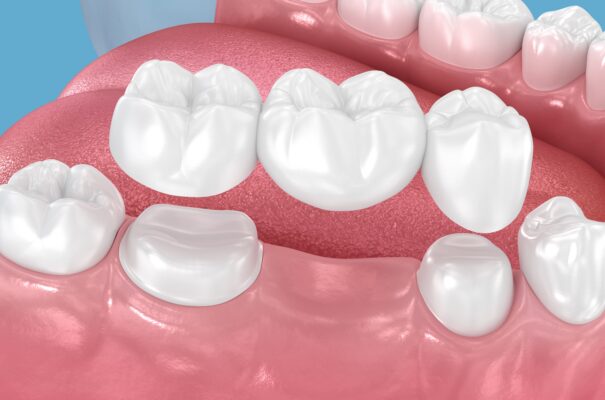 If you are missing just a few teeth in a row, a fixed dental bridge may be an option. Because a fixed dental bridge cements into place, you cannot remove it.
A fixed bridge can replace a row of missing teeth. A traditional dental bridge has crowns on either side that are secured to neighboring teeth, called abutment teeth. To prepare the abutment teeth, Dr. Keider must remove some enamel to make space for the crown, which is a permanent change. A fixed bridge can be an especially good option when the teeth next to the missing space already need crowns.
Another option for a fixed bridge is an implant-supported bridge. An implant-supported bridge is similar to a conventional bridge, except that it uses implants as abutments instead of natural teeth. This means that neighboring healthy teeth remain unchanged.
One of the biggest advantages of a fixed bridge is that it does not take up any extra space in the mouth. So it may feel more natural than a bulkier partial denture.
Dental Bridges vs. Partial Dentures: Key Differences
Both dental bridges and partial dentures have their place in dentistry, and you do not have to make the decision on your own. Dr. Keider can explain the benefits of each option based on your specific situation.
The biggest difference between a dental bridge and a partial denture is that a bridge is fixed in place, while a partial denture is removable.
A partial denture can replace several missing teeth, including teeth in different areas of the mouth. In contrast, a dental bridge can replace one or more adjacent missing teeth and relies on neighboring abutment teeth or dental implants for support.
Ultimately, the best choice depends on factors such as the number and location of your missing teeth, as well as your treatment goals and budget.
Explore Your Options at an Affordable Consultation
There is no single tooth-replacement option that is right for every patient. A partial denture, traditional dental bridge, or implant-supported bridge may each make sense in different situations. The best way to understand your options is to come in for a personalized assessment. Dr. Keider can answer your questions and determine which approach fits your dental needs and budget.
Learn more at an affordable consultation.