
![Small-Diameter Dental Implants in Winston-Salem [Video Q&A]](https://keiderdds.com/wp-content/uploads/2026/07/Small-Diameter-Dental-Implants-in-Winston-Salem-Video-QA.jpg)
Dental implants make it possible to replace missing teeth with realistic, functional results. They can replace a single missing tooth with a crown, a row of teeth with a bridge, or an entire set of upper and lower teeth with an implant denture. If you’ve been told you don’t have enough bone for a dental implant, small-diameter dental implants may provide another option worth exploring.
Many patients learn they need bone grafting before they can receive implants because conventional-sized implants are quite large. Bone grafting is an oral surgery procedure that adds time and discomfort to the process. However, mini implants, which feature a much narrower diameter, can fit into narrower jawbones.
When Dr. Keider sees you for a personalized implant consultation, he can assess your jawbone health and determine whether smaller implants could help you complete your smile sooner.
Limitations of Conventional-Size Dental Implants
A dental implant is a titanium screw placed into the jawbone. It replaces the root of a missing tooth and supports a fixed or removable replacement. Implants have been around for decades and have a reputation for providing replacements that feel quite natural.
A key question, particularly with conventional, larger-sized implants, is whether your jawbone can support them. A conventional implant is larger in diameter, ranging from 3 to 8 mm. Moreover, it requires sufficient surrounding bone to remain stable. When that bone isn’t present, dentists recommend grafting.
Having to undergo bone grafting adds a costly procedure to the implant placement process. It also extends the timeline until you’re smiling with your final tooth replacement.
But the technology has improved significantly over time, especially with the introduction of small-diameter dental implants, which have simplified the placement procedure. Mini implants are placed using a minimally invasive procedure, reducing costs and healing time. Most patients who want implants can achieve a complete smile once again, thanks to the advantages of small-diameter dental implants.
Small-Diameter Dental Implants Work for Patients With Less Jawbone
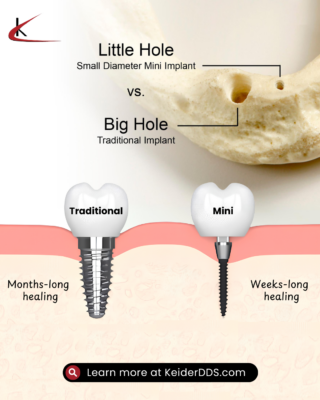 Mini dental implants, also called small-diameter dental implants, are much smaller in diameter than traditional implants. Dr. Keider explains that “the best use of mini-implants is for areas where there is not a lot of bone. Those mini-implants can be placed in those thin areas of bone, shorter areas of bone, and many times don’t require bone grafting.”
That smaller size also makes the procedure much simpler, allowing patients to skip bone grafting in many cases. As a result, placing small-diameter dental implants “doesn’t take as much time, and it can be a very simple procedure rather than being very in-depth,” he says. Dr. Keider places the small-diameter dental implants and attaches the crown, bridge, or denture in far fewer visits. This helps you return to your normal routine sooner, with a more complete smile that you’re happy with.
Small-diameter dental implants can support a range of tooth replacement options. Depending on your bone volume and what you’re looking to achieve, that may mean a removable restoration or a fixed one. Dr. Keider determines which options your specific anatomy supports.
How Dr. Keider Customizes Care for Every Patient
How does Dr. Keider find the best option for your smile? He customizes every treatment plan to you, the patient, depending on how much bone you have.
When you come in for a consultation, Dr. Keider takes a CBCT scan first. That scan produces a 3D image of your head and mouth to see exactly how much bone you have and where. He reviews it with you, goes over your options, and builds a treatment plan based directly on that imaging and his decades of dental experience to determine what will perform best in your mouth over time.
Dr. Keider brings that level of personalization to every single patient he works with. When patients seeking implant-supported solutions see it firsthand, they don’t just leave our practice with a complete smile. They leave with a reason to smile. Here’s what Karen Teal said about her experience:
Love Dr. Keider and everyone there! He is so gentle and lets you know everything he’s doing…no surprises. I was so happy he could do my dental implant and didn’t have to go somewhere else—very pleased with it. He and the staff are the best.
Just like we’ve supported Karen and countless other happy patients, we’re excited to help you restore the teeth you’ve lost. He’ll clarify exactly why small-diameter dental implants may best suit your needs after a detailed assessment.
Explore Small-Diameter Dental Implants at a Consultation
Not every patient needs bone grafting before getting implants. For many people with thin or narrow bone, small-diameter dental implants require less time and less healing than the grafting process. Dr. Keider places the implants and attaches the crown, bridge, or denture, often in a single visit or two.
Dr. Keider evaluates each patient individually based on the imaging and builds a treatment plan tailored to your specific situation. Many patients who were told bone grafting was their only option turn out to be candidates for small-diameter dental implants instead.
If another dentist has told you bone grafting is your only option, call our Winston-Salem office to schedule a consultation with Dr. Keider.